Learning from Deaths
Wide
Off
Off
Learning from deaths of people in their care can help hospitals improve the quality of the care they provide to patients and their families, and identify where they could do more.
In March 2017, the National Quality Board (NQB) introduced new guidance for NHS providers on how they should learn from the deaths of people in their care.
The purpose of the guidance is to help standardise and improve the way acute, mental health and community trusts identify, report, review, investigate and learn from deaths, and engage with bereaved families and carers in this process.
At North Bristol NHS Trust we have been working with our clinical teams so that we meet the requirements of the new guidance. Our aim is to improve the care of our patients by identifying learning from excellent care at the end of life as well as identifying areas where we need to make improvements.
Download and read
ICU Simulation
Wide
Off
Off
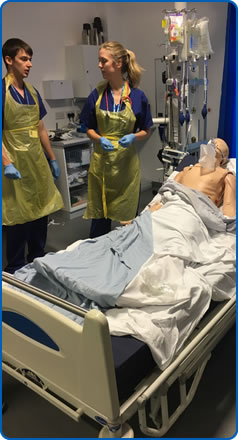 The ICU at North Bristol NHS Trust (NBT) is unique in being the only ICU in the country with dedicated simulation facilities within the unit. We have two patient rooms, each with a Laerdal manikin set up for simulation training. The rooms lend themselves towards Critical Care training, but we also have equipment to run anaesthetic and trauma based scenarios.
We currently host a number of dedicated courses, predominantly Critical Care based, but also anaesthetic, trauma, surgery and general ward based simulation. These courses include:
- the Transport Course (multi-disciplinary course dealing with Critical Care transfers)
- New2ICU (regional critical care course for junior doctors)
- the Acute Critical Care Practitioner Course (a nursing course leading to a postgraduate qualification).
ICU Fellowships
Wide
Off
Off
The 46 bed Southmead Intensive Care Unit is one of the busiest ICUs in the country, with a team of over 300 staff treating more than 2,200 critically ill patients each year.
Southmead ICU cares for emergency and elective patients from all medical and surgical specialities except cardiac, ENT and paediatrics. We are the regional specialist critical care centre for major trauma, neurosurgery, renal medicine, plastics, and burns, and are delivering some of the highest intensive care and major trauma survival rates in the country.
Intensive Care Clinical Fellows CT1/2 Level
These posts are advertised as “Clinical Fellow (CT1/2 equivalent) in ICU/ED” on NHS Jobs. The posts are generally advertised in March/April each year for an August start-date, although positions may become available at other times of the year. Two types of post are available - 12-month posts in Intensive Care Medicine, and split-posts which involve 6 months of ICM and 6 months of Emergency Medicine.
The minimum requirements for these posts are completion of foundation training (or equivalent), however these posts are also popular with those who have completed core training in another specialty who are considering a career in intensive care medicine, or would simply like to improve their clinical skills in caring for critically ill patients. The posts are educationally sound, with regular protected teaching time. Each post-holder is supported by a named educational supervisor.
For further information please contact Dr Dom Janssen, ICM Consultant, Faculty Tutor on email dominic.janssen@nbt.nhs.uk
Intensive Care Clinical Fellows ST3/4 Level
These popular posts are advertised as “Clinical Fellows in Anaesthesia and/or Intensive Care (ST3 level)” on NHS Jobs. The posts are generally advertised in March/April each year for an August start-date, although positions may become available at other times of the year. The positions are suitable for trainees who have completed core training in any of the complementary specialties (Anaesthesia, Emergency Medicine, Acute Medicine or CMT).
These posts come with protected time to develop your CV by participating in Quality Improvement, Research and/or Education with the support of the ICU consultants. The fellowships are also an outstanding opportunity to develop clinical and procedural skills in intensive care medicine, including echocardiography, major trauma management, and neurocritical care. The posts are focused on career development, and each post-holder is supported by a named educational supervisor.
For further information please contact Dr Dom Janssen, ICM Consultant, Faculty Tutor on email Dominic.Janssen@nbt.nhs.uk
Critical Care Fellowship
Our Critical Care Fellowship programme is suitable for post CCT or senior trainees, from both the UK and overseas, with a strong interest in high quality critical care, who wish to gain further experience of managing complex patients in a busy regional specialist centre. Successful applicants will have a senior clinical role in a medical team of 24 ICU Consultants and more than 35 ICU trainees. There is extensive opportunity to gain leadership and management experience and Fellows will be encouraged to assist in the development and delivery of projects and new services.
The Fellowship programme includes one day per week of scheduled career development time to pursue subspecialty interests of the Fellow’s choosing. Opportunities include, but are not limited to, research, major trauma, echocardiography, neuro critical care, and simulation, supported by Consultants with matching interests. As a University Teaching Hospital there are active research programmes in critical care and major trauma and Fellows could expect to gain peer reviewed publications during the term of the Fellowship.
For further information please contact Dr Julian Thompson, ICM Consultant on email julian.thompson@nbt.nhs.uk
ICU In-house Teaching
Wide
Off
Off
Southmead ICU Trainee Teaching Programme
Monday
Neuroradiology MDT 8am-8.30am. Guy Jordan Seminar Room (GJSR)
Review of neuro-imaging with interventional neuroradiologist + neurosurgeons.
Teaching 12.30pm-1.30pm. Guy Jordan Seminar Room (GJSR)
Core ICM Topic Presentation by ICU trainee. Facilitated by ICM Consultant
ICU MDT Meeting 1.30pm-3.30pm. Guy Jordan Seminar Room (GJSR)
Attended by medical / nursing staff + AHPs. Topics vary by week and include M+M / journal club / audit / social media update
Tuesday
Neuroradiology MDT 8am-8:30am. Guy Jordan Seminar Room (GJSR)
Review of neuro-imaging with interventional neuroradiologist + neurosurgeons
Radiology Case Review / Teaching 1pm-2pm. Guy Jordan Seminar Room (GJSR)
XRay meeting for ICU medical staff. Led by consultant radiologist
Wednesday
Neuroradiology MDT 8am-8.30am. Guy Jordan Seminar Room (GJSR)
Review of neuro-imaging with interventional neuroradiologist + neurosurgeons
Radiology Case Review / Teaching 1pm-2pm. Guy Jordan Seminar Room (GJSR)
XRay meeting for ICU medical staff. Led by consultant radiologist
Thursday
Neuroradiology MDT 8am-8.30am. Guy Jordan Seminar Room (GJSR)
Review of neuro-imaging with interventional neuroradiologist + neurosurgeons
Grand Round/Ploughman’s Lunch 1pm-2pm. Guy Jordan Seminar Room (GJSR)
Case presentation and discussion
Friday
Neuroradiology MDT 8am-8.30am. Guy Jordan Seminar Room (GJSR)
Review of neuro-imaging with interventional neuroradiologist + neurosurgeons
Radiology Case Review / Teaching 1pm-2pm. Guy Jordan Seminar Room (GJSR)
XRay meeting for ICU medical staff. Led by consultant radiologist
Other training taking place at flexible times
- Consultant-led FFICM Viva + OSCE practice sessions (often following Monday MDT)
- Echocardiography (FICE) mentoring
ICU Useful Links for Clinicians
Wide
Off
Off
South West Critical Care Network
www.uhbristol.nhs.uk/for-clinicians/swccn
Faculty of Intensive Care Medicine
Intensive Care Society
Society of Intensive Care of the West of England
British Association of Critical Care Nurses
Critical Care Network National Nurse Leads
ICU National Guidelines
Wide
Off
Off
Guidelines for the Provision of Intensive Care Services (GPICS)
https://ics.ac.uk/guidance.html
ICS Guidelines + standards
ics.ac.uk/ICS/guidelines-and-standards
ICS Advisory documents including sample LocSSIPs and management support tools
ics.ac.uk/ICS/Advisory-Documents
FICM guidelines: including antimicrobial stewardship, guidance for training units and forms for the diagnosis of death using neurological criteria
ficm.ac.uk/standards-and-guidelines/access-standards-and-guidelines
FICM NICE guidance relevant to intensive care, including head injury management, organ donor identification guidance, pneumonia in adults management
ficm.ac.uk/standards-and-guidelines/nice-standards-guidelines
ICU Charitable Fund
Wide
Off
Off
Our Intensive Care Unit has benefitted from incredibly generous donations and fundraising attempts for our ICU Charitable Fund (managed by the Southmead Hospital Charity). Donations can help to improve patient care by funding:
- Life-saving equipment
- Pioneering research
- Staff training and development
- Improved facilities for our patients
Recent donations have funded:
- Emergency airway equipment, giving us access to the latest technology and improving patient safety.
- Advanced forms of brain monitoring, improving the care we deliver to patients admitted with traumatic brain injuries.
- A patient transfer trolley for occasions when we urgently need to transfer a patient to a different hospital for specialist care.
- A bespoke electronic Clinical Information System meaning all clinical data is instantly accessible on one system at the patient’s bedside.
- In addition, we were able to establish our ICU Follow-Up Clinic. This was funded for over a year through charitable funding and allowed us to demonstrate the great benefit of this service. This led it to become an established part of our unit.
- Communication aids for patients
- Patient radios and headphones
- Children’s books and toys for our ICU waiting room
- Provide live music for patients and relatives
Donations have also helped us to improve the patient experience. We have been able to purchase:
If you would like to make a donation, you can donate to the ICU Charitable Fund via the Southmead Hospital Charity.
Southmead Maternity Virtual Tour
Wide
Off
Off
This tour allows you take take a virtual walk through Southmead Hospital Maternity Unit. Please speak to your midwife about having your baby at Southmead Hospital Maternity Unit.
Cossham Birth Centre Virtual Tour
Wide
Off
Off
Take a virtual walk through Cossham Birth Centre. Please speak to your midwife about having your baby at Cossham Birth Centre.