Palliative Care & End of Life - For Clinicians

Wide Off On Services & Referral End of Life Care - For GPs

Palliative Care Home Support Service

The Palliative Care Home Support Service (PCHS) provides personal care and emotional support for patients who wish to be at home in the last 4 to 6 weeks of life. The team visits patients across the Bristol and South Gloucestershire areas.

The service can provide 1 to 3 care visits to patients between 9am and 9pm for patients registered with a Bristol GP and 1 to 2 care visits to patients between 9am to 5pm for patients registered with a South Gloucester GP.

The service accepts patients with any diagnosis however; they must meet the following criteria:

  • 18 years of age or older
  • Assessed as being in the last 6 weeks of life
  • Registered with a GP in the Bristol or South Gloucestershire area

Referrals can be made by any health or social care professional; by either fax or by telephone.

Bristol Care Co-ordination Centre (BCCC) for End of Life Care, co-ordinates the care for patients considered to be within the last 3 months of life.

  • Marie Curie
  • Hospice at Home
  • The Fast Track Team who link closely with BCCC
Palliative Care & End of Life

Medicines Formulary

Wide Off Off

North Bristol NHS Trust uses medicines according to the BNSSG Joint Formulary, which can be found at www.bnssgformulary.nhs.uk/. The BNSSG Joint Formulary is regularly updated and monitored by the BNSSG Joint Formulary Group, which includes NBT, University Hospitals Bristol NHS Foundation Trust, Weston Area Health NHS Trust and the local Clinical Commissioning Groups (formerly Primary Care Trusts).

The BNSSG Joint Formulary promotes medicines which are safe, effective and value for money. It is a joint venture between primary and secondary care ensuring that patients have continuity of medicines whether at home or in hospital.

Clinical Trials

Wide Off Off

Clinical trials are undertaken to develop better medicines, an improved understanding of medicines' studies and to improve the safety of medicines.

All trial protocols are assessed by the Local Research Ethics Committee (LREC) to ensure that the trial will be safe and will add to the sum of knowledge about medicines.

Only when the LREC is satisfied can patients be recruited for the trial. Each trial is run according to a strict protocol and procedures are in place to ensure that all records are kept up to date. Only Senior Doctors are permitted to introduce a patient to a trial.

Take Part in Research

Speak to the person treating you to see if there is a research trial or study suitable for you. 

Ward Pharmacy Services

Wide Off Off

All registered clinical pharmacists have undergone a degree in Pharmacy followed by a Pre-Registration period of one year. Most pharmacists have also undertaken a postgraduate clinical diploma qualification. They work in conjunction with pharmacy medicines management technicians looking after a patient’s drug supply and therapy whilst they are in hospital.

Most wards receive a daily visit by a clinical pharmacist. The pharmacist will check a patient’s drug therapy whilst they are in hospital to ensure they are taking the medication that patients were having at home.

Pharmacists work closely with the medical, nursing and other healthcare teams to make sure the patients are taking the right medicines and they are all ok to be taken together, as well as plan for the patients discharge.

Many pharmacists have a specialist role in a particular field and so work as part of a team in that area with the doctors and nurses.

Medicines management technicians are qualified in NVQ level 3/BTEC in pharmacy and registered with the General Pharmacy Council. They are ward based and are part of the ward team. They help improve workflow in the dispensary by planning ahead for discharge.

When patients are admitted the technician will obtain details of the patient’s medication prior to admission from a variety of sources: patient, patients own medication, carers, relatives, GP surgeries, nursing homes and community chemists. This information is referred to the ward pharmacist who then reconciles the information within 24 hours after admission as guided by the ‘Safer Patient Initiative’

We encourage patients to bring in medication at admission so that the technician can assess its suitability for future use, both during their stay and at discharge and also to highlight compliance issues. Medication is stored in individual medication lockers located at the bedside.

Technicians monitor the drug chart for missed doses, supply, omissions, and endorses important instructions against each medicine regarding appropriate administration.

Technicians provide counselling to patients on how to take their medication.

Approaching the discharge stage, technicians and pharmacists can help with organising the ‘take home’ medication in a timely manner.

Diabetes Useful Links

Wide Off Off

Diabetes General Links

www.diabetes.org.ukDiabetes UK is the leading diabetes charity in the UK. They have an excellent website that covers all aspects of diabetes care for both Type 1 and Type 2 diabetes.  We recommend that if you want further information on any area of your diabetes you use this website first.
www.runsweet.com - To find out more information about sporting activities and diabetes.
www.bertieonline.org.uk - To find out more on the basic principles of carbohydrate counting.
www.ukdrn.org - Find out more about our research.
 

Driving and Diabetes

If you drive and are on medication for diabetes you may need to inform DVLA.
The following sources give further information about driving with diabetes:
Diabetes UK Careline 0845 120 2960
DVLA: www.gov.uk/diabetes-driving

Diabetes Technology

progress.freestylediabetes.co.uk - To learn more about how to get the most from using the FreeStyle Libre flash glucose monitoring system.
www.nice.org.uk/guidance/TA151/chapter/1-guidance - To review current guidance for the use of insulin pumps in diabetes.

Respiratory Outpatients

Wide Off Off

The North Bristol Lung Centre runs a number of general respiratory and specialist respiratory outpatient clinics. These include clinics run by doctors, specialist nurses, pharmacists, physiotherapists and other healthcare professionals.  The clinics take place at:

  • The Brunel building, Southmead Hospital 
  • Cossham Memorial Hospital Clinic
  • Thornbury Hospital Clinic

Contact details

For outpatient appointments  : 0300 555 0103

Respiratory secretaries: 0117 414 2016

AAC WEST Products

Wide Off Off

AAC WEST has a range of products, developed by the centre’s experienced specialists.

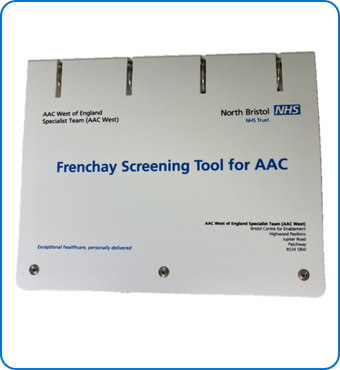
Frenchay Scrrening Tool for AAC front cover white background blue text

The Frenchay Screening Tool for AAC

This tool has been designed for use by professionals working with people with communication needs who wish to assess their patient’s suitability for using AAC.

This simple and easy to use tool brings together a range of specific assessment areas into one simple tool. This robust and meaningful tool allows the administrator to look at areas such as the patient's physical access, visual acuity, visual processing, symbol versus written word identification, categorisation etc. 

The results from this screen can be used to ensure appropriate onward referrals are made to specialist AAC assessment centres. 

Costs and how to purchase:

The Screening Tool costs £100 +VAT and P&P (£15.00 p&p for 1, please ask for p&p quote if ordering more then 1x screening tool). 

The Frenchay Screening Tool can be purchased by contacting the AAC WEST Service. Please send all purchase orders or enquiries to aacwestadmin@nbt.nhs.uk

(Please note that the purchase order must state clearly both the address you would like us to deliver the screening tool(s) and also the full name and address details of whom to invoice. It would also be useful if you could provide a contact telephone number).

Please note that the following bodies are outside English NHS VAT Division and therefore are subject to the normal VAT rules.  This means that if your Company is on this list, please add VAT to your purchase order:

  • NHS Bodies in Scotland 
  • NHS Bodies in Wales 
  • NHS Charities 
  • Moorfields NHS Foundation Trust 
  • GP Surgeries 
  • NHS Property Services 
  • All other VAT registered entities 
  • Public Health England 
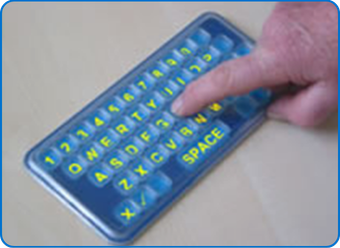
Frenchay Alphabet Board (FAB) on table with finger touching board on letter H
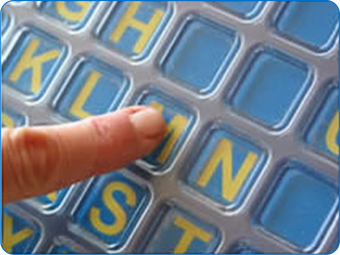
Close up shot of finger touching the letter M on a Frenchay Alphabet Board

Frenchay Alphabet Board (FAB)

The Frenchay Alphabet Board (FAB) is a communication tool designed to help people spell out words when speech is difficult. 

Each letter sits in a shallow dip or groove. These dips give the person’s finger a place to settle, which helps with accuracy and control. This makes it especially helpful for people with motor coordination challenges or conditions affecting arm/hand stability. It allows them to spell messages more easily and reliably, supporting clearer, more independent communication.

The FAB has been designed to be compliant with infection control standards and is therefore ideal for use on hospital wards or in nursing homes as it is fully washable and MRSA and E-Coli resistant.

The FAB has been developed in conjunction with E2L products. 

Visit FAB™ | The Frenchay Alphabet Board to watch a video. 

The FAB is not currently available to buy in the UK.  We hope to make it available again soon. A similar alphabet board can be bought from Dad In A Shed Letterboard.


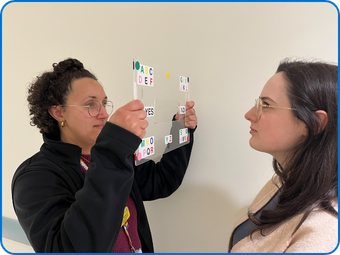
Person holding up E-Tran Frame in front of another person
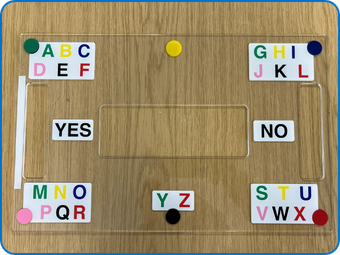
Plastic clear rectangle with letters in bright colours in each corner, yes and no on each side

E-Tran (Frenchay Eye Transfer Frame)

The Frenchay Eye Transfer (E-Tran) Frame is a simple but effective eye pointing system of communication, designed for people who cannot point to letters with fingers/hands.

The letters of the alphabet are displayed in groups, and colour coded.  The communication partner holds the frame and looks through the central window at the AAC user’s eyes.  A letter is identified by the AAC user first looking at the group containing the letter, and then indicating the colour by looking at the coloured dot. Words and sentences can be built up in this way. 

The Frenchay E-Tran is not currently available to buy.  We hope to make it available again soon. A similar E-Tran frame can be bought from Liberator E-Tran Frame which comes with letters. 
Stroke Useful Links

Wide Off Off

The Stroke Association - Charitable organisation providing free Information for Individuals & Families www.stroke.org.uk

South Gloucester Council - A directory of useful services. Search 'stroke' to access their directory www.southglos.gov.uk

Bristol Area Stroke Foundation www.stroke-bristol.org

Living (dlc) - Formerly the Disabled Living Centre www.thisisliving.org.uk

Home from Hospital service - (British Red Cross) www.redcross.org.uk

Purple Pages www.thecareforum.org