Adult Major Trauma Centre

Wide Off Off

North Bristol NHS Trust is one of two designated Major Trauma Centres in South West England, servicing the Severn region. 

The Major Trauma Centre, supported by six acute trusts as designated trauma units, helps increase the chances of survival and recovery for seriously ill patients. 

The Brunel building, Southmead Hospital, is equipped with a helipad and a major specialty for: 

  • Neurosurgery 

  • Burns 

  • Plastics 

  • Pelvic Surgery 

  • Open Fractures 

As a Major Trauma Centre, Southmead Hospital will ensure that patients who are admitted have access to specialist equipment and a full range of trauma specialists, including orthopaedics, neurosurgery and radiology teams. 

This will help improve patients’ chances of survival and help them recover faster; it is estimated that survival rates are increased by up to 30%. 

In addition to clinical teams, we have a team of experienced nurses and therapists who are available specifically to coordinate the care of seriously injured patients and provide support and information to patients and families both during and after their stay at the Major Trauma Centre. 

Understanding the impact of the COVID-19 pandemic on the early speech and language development of children born with cleft lip and/or palate.

Wide Off Off

Investigators: Lucy Southby, Yvonne Wren, Amy Davies, Sharon Baker, Helen Extence, Neil Brierley

Timescale: January - December 2023

Funder: CLEFT Bridging the Gap Charity https://www.cleft.org.uk/

Children born with cleft palate are at risk of speech problems and delayed early language development. During the COVID-19 pandemic, treatments for children born with a cleft were often delayed and the environment that young children were exposed to was different because of lockdowns, social distancing and facemasks. This research aims to understand whether these differences from the pandemic have had an impact on the early speech and language development of children born with a cleft. Using data from The Cleft Collective cohort studies, this work will describe the early speech and language skills of children born with a cleft (up to age 2 years) who were born just before or during the pandemic and compare them to children who reached age two years before the pandemic started.


BSLTRU Events

Wide Off Off

Upcoming events

 Innovation in Action: Empowering SLTs in the South West Through Connection

Innovation in Action: Empowering SLTs in the South West Through Connection and Community, is set to relaunch the RCSLT's South West Hub by providing an exciting opportunity for SLTs, researchers, Therapy Assistants and students to come together to build connections and share knowledge, experiences and best practices.

Taking place on Friday, July 11 at the Taunton Conference Centre at Taunton College, the full-day event will begin with bit of networking over tea, coffee and biscuits before a mix of presentations and workshops - sandwiching a free buffet lunch - and numerous chances to network with your regional SLT colleagues.

The event is free to attend for RCSLT members based in the South West (please have your RCSLT membership number at hand when ordering your ticket) but please note that places are limited due to venue capacity. Extensive car parking is available on-site, with a daily charge of £1, while the venue is around a 15-minute walk from Taunton station.

For more information visit cmemailmarketing.co.uk

To secure your place visit Innovation in Action: Empowering SLTs in the South West Through Connection Tickets, Fri 11 Jul 2025 at 09:30 | Eventbrite

Past Events

BSLTRU and Underwood Trust Annual lecture

Title: All Children Should be Seen AND Heard: The Importance of Communication so Children can Thrive

We are happy to announce that this year’s BSLTRU and Underwood Trust Annual Lecture is taking place on Tuesday, 30th of April at 4 pm, in the Lecture Theatre in L&D Building at Southmead Hospital. Our guest speaker this year will be Professor Sharynne McLeod from Charles Sturt University, Australia. Professor McLeod, is a speech-language pathologist and professor of speech and language acquisition at Charles Sturt University, Australia. She is a Fellow of the Academy of the Social Sciences in Australia and the Royal Society of New South Wales. She has received Honors of the American Speech-Language-Hearing Association, Life Membership of Speech Pathology Australia and has been an Australian Research Council Future Fellow.

RCSLT Conference 2023. Embracing the future together.

1-2 November 2023

I am attending logo

The RCSLT is hosting their biannual conference online again this year on the 1-2 November. The conference promises "two days of opportunities for learning, professional development, and networking". Colleagues at BSLTRU and Cardiff Metropolitan University (CMU) will be presenting their research at this event. ​

​The conference is exceptionally good value, making it very accessible. We are planning on extending this inclusive event by hosting opportunities to gather 'in-person' at Southmead (Weds 1st Nov) and Cardiff Llandaff campus (Thurs 2nd Nov). BSLTRU/CMU will make several rooms available over the 2 days so that colleagues registered to attend the conference can gather to watch and discuss parallel sessions. We hope this will provide an enhanced networking opportunity and give colleagues the chance to critically engage with the conference content. ​

​For more information go to: www.rcslt.org/events/rcslt-conference-2023/section-1

If you are interested in joining us for the conference, please email dominika.kruszynska@nbt.nhs.uk to express your interest​ by 20th October 2023.

BSLTRU and Underwood Trust

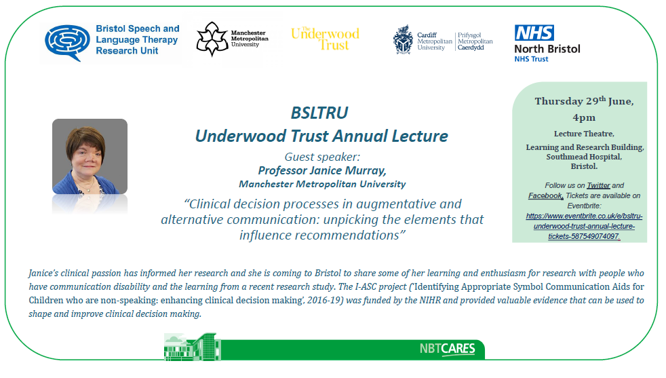
BSLTRU and Underwood Trust were pleased to host our Annual Lecture on the 29th of June 2023 in the Lecture Theatre at Southmead Hospital in Bristol. Our guest speaker was Professor Janice Murray from Manchester Metropolitan University who presented on: “Clinical decision processes in augmentative and alternative communication: unpicking the elements that influence recommendations”.

BSLTRU Underwood Lecture Information

Partnership with Cardiff Metropolitan University’s School of Sport and Health Sciences

BSLTRU is partnered with Cardiff Metropolitan University’s School of Sport and Health Sciences which trains speech and language therapists in the region. BSLTRU leads the Clinical Research Strand in the Speech, Hearing and Communication Research Group within the University.

To officially mark the occasion of this partnership, a launch event is took place on Wednesday 22 June 2022 at Cardiff School of Management.


Cardiff Met and BSLTRU Partnership Launch event

Haematology HIT Guidance

Wide On Off

At North Bristol NHS Trust the test used to investigate a potential clinical diagnosis of HIT is an ELISA for heparin/PF4 antibodies.

A pretest probability should be calculated and the need for investigation discussed with a haematologist. The assay will not be performed without a 4Ts score.

 Estimating the pretest probability of HIT: the ‘four Ts’


Points
 (0, 1 or 2 for each of four categories: maximum possible score =8)

2

1

0


Thrombocytopenia

> 50% fall or platelet nadir 20–100x 109 per l

30–50% fall or platelet nadir 10–19x 109 per l

fall <30% or platelet nadir <10x 109 per l

Timing* of platelet count fall or other sequelae

Clear onset between days 5 and 10; or less than 1 d (if heparin exposure within past 100 d)

Consistent with immunisation but not clear (e.g. missing platelet counts) or onset of thrombocytopenia after day 10


Platelet count fall too early (without recent heparin exposure)

Thrombosis or other sequelae (e.g. injection site lesions)

New thrombosis; skin necrosis; post heparin bolus acute systemic reaction

Progressive or recurrent thrombosis; erythematous skin lesions; suspected thrombosis not yet proven

None


Other causes for thrombocytopenia not evident
 

No other cause for platelet count fall is evident

Possible other cause is evident

Definite other cause is present

Pretest probability score: 6–8 = high; 4–5 = intermediate; 0–3 = low.  
*First day of immunising heparin exposure is considered day 0; the day the platelet count begins to fall is considered the day of onset of thrombocytopenia (it generally takes 1–3 d more until an arbitrary threshold that defines thrombocytopenia is passed).


If the pretest probability is low consider whether a HIT heparin/PF4 antibody assay should be performed.  If the pretest probability is high, heparin should be stopped and an alternative anticoagulant given whilst laboratory tests are performed.

The immunological tests have high sensitivity, 80–100%, for heparin/PF4 antibodies but the diagnostic specificity for the clinical syndrome of HIT is low. A strongly positive test indicates a much greater likelihood of HIT than a weakly positive test.

Haematology HIT Guidance

Gastrointestinal (GI) Physiology

Wide Off On A-Z of Services

Gastrointestinal (GI) physiology is an outpatient service offering investigations and support for patients experiencing symptoms such as:

  • Constipation
  • Faecal incontinence
  • Difficulty swallowing
  • Acid reflux.

Tests offered

  • Hydrogen breath tests (SIBO/lactose intolerance/fructose intolerance)
  • Anorectal physiology +/- biofeedback
  • Trans-anal irrigation
  • Oesophageal manometry & overnight pH/impedance testing

All the above tests can be offered on the NHS or privately. For private patients, please contact us for further information.


Useful links

Contact GI Physiology

Gate 36, Level 1,
Brunel building, 
Southmead Hospital,
Bristol
BS10 5NB

Phone: 0117 414 8801
Email: GIphysiology@nbt.nhs.uk

Gastrointestinal (GI) Physiology

Vascular Testing - For Clinicians

Wide Off On Services & Referral

Please make referrals to vascular testing for investigations via the ICE system.

Clinicians can refer to the Vascular Network via NHS eReferrals where possible, or by refer a patient. 

Please visit Vascular Services - For Clinicians for more details and urgent referrals

To speak to a member of the Vascular Testing team to discuss referrals or results, please call  0117 414 5300

Our opening hours are 8 am – 6 pm Monday to Friday. Any referrals made after 4:30 are not guaranteed to be performed on the same day. Any urgent referrals made after 4:30, please call the department. Please leave a voicemail outside of these hours if necessary and we will return your call.

Deep vein thrombosis scan

Requests are no longer accepted by primary care. Please refer to GP Care for this assessment by visiting Deep Vein Thrombosis - GP Care

Vascular Testing

Work Experience

Wide Off Off

Work Experience

We work closely with local schools and colleges to provide opportunities for young people to gain knowledge and experience of different roles and raise awareness of career options and job opportunities within the NHS.

There are over 350 potential career options in healthcare and opportunities for work experience include clinical and administrative areas, allowing participants to learn about working in the NHS, develop new skills, learn about their strengths and weaknesses and increase their confidence.

Learning and Development organise various opportunities for young people to gain experience of the NHS and our Trust. These include:

  • Tours of departments.
  • Careers events.
  • Work shadowing.
  • Taster/observation days.
  • Mock interviews and work experience programmes, including traineeships and sector-based academy learners.

To find out more about work experience opportunities within our Trust, please email workexperience@nbt.nhs.uk.

Vascular Testing Frequently Asked Questions

Wide Off Off

Where will I be seen?

If you are an inpatient, you will be seen by a member of the team on the ward with a portable scanning device. You may be asked to attend our department at gate 5a but this will be communicated to you and you will be transferred by the hospital portering service.

If you are sent an outpatient appointment letter, it will advise you on the outpatient setting that you should attend and how to check in for your appointment. 

Once checked in, you will come to our dedicated vascular testing waiting room. Here there are toilets, including disabled facilities next to the waiting room.


For your appointment, you will be taken to one of the ultrasound rooms where it will be explained to you what investigation is going to be performed. Depending on the type of investigation you will be advised as to what clothing or jewellery needs to be removed. You may be asked to lie/sit on the couch or stand next to it. If you find a particular position uncomfortable, please let us know so we can adapt the scanning position to make you more comfortable.

The vascular scientist or technician will put ultrasound gel on the area to be examined and will place a soft-faced transducer or probe, which is attached to the ultrasound machine, on your skin to create the ultrasound images or sounds as required so that a diagnosis can be made.

Occasionally there may be medical or other students observing.  All staff present will be introduced to you and you will be asked if you mind students being present during the investigation. If you prefer not to have students observing, it is fine to tell the examiner and it will not affect your treatment in any way.

How long does the test take?

The type of test and how long it will approximately take will be indicated in your appointment letter.

Your visit to Vascular Testing could take anything from 15 minutes for a simple Doppler test up to 90 minutes for a full scan of both legs. If you require more details, please contact us.

Are there are special preparations?

Minimal patient preparations are required for the test. You can eat, drink and take medication as normal, however, if you are coming for a Duplex scan of your legs or abdomen you may want to have a light breakfast or lunch and avoid fizzy drinks.  

If you are diabetic, please ensure you bring your medication, food or money to purchase food in case of delays.

Will I need to undress?

An ultrasound needs direct contact with the skin. You will be asked to remove specific items of clothing or jewellery so we can get clear access to your skin in the areas where the investigation needs to be performed. It is recommended that you wear something comfortable which is easy to take on and off. The vascular scientist or a support worker can help you if you have any difficulty.

The dignity and privacy of our patients is of the utmost importance and the examination will be performed in a private scanning room. You will be given a towel if you are asked to remove an item of clothing.  If you would specifically prefer a male or female member of staff, please let us know, preferably by contacting us prior to your appointment.

Can I bring someone with me?

There is room in the scanning room for one friend or relative if you require additional support during the scan. 

I have dressings – will you change them?

We are unable to redress any leg wounds or ulcers. Please arrange with your health centre to have any dressings reapplied or changed at a convenient time after your appointment.

Will it hurt?

No, for a vascular ultrasound scan there are no injections, no needles and no chemicals or x-rays. Depending on how deep the blood vessels are the vascular scientist or technician may need to press quite firmly and this can sometimes feel a bit uncomfortable but they will do their very best to keep any discomfort to a minimum.

The worst part of the scan for most people is the gel and that is because it’s cold. The gel will be wiped off after the test, it is water-based and does not stain clothing.

Is the test safe?

Vascular ultrasound tests are safe and non-invasive (no injections).

Do I have to go in a tunnel?

No, there are no tunnels or confined spaces involved.

Can I drive afterwards?

Yes – unless you have been told by your doctor not to because of your condition.

When will I receive the result?

At the end of the scan, if you would like to know the findings, we can discuss the scan with you and will try to answer any questions you may have.  

We cannot tell you what your treatment will be as this is a discussion between you and the referring doctor however we can try and answer any questions you may have regarding the different types available.

We cannot discuss any potential treatment options as this will be a discussion between you and the referring doctor.

The test result will be communicated to the referrer and the result will be available to view on the hospital reporting systems within 24 hours.

Who will book my hospital transport?

We do not book hospital transport but please call the vascular testing administration team if you will be booking transport as we may need to rearrange your appointment time. This is to avoid late return journeys home which cannot be guaranteed if your appointment is after 2pm. The vascular testing administration telephone number can be found in your appointment letter.

If you are attending on transport please bring regular daytime medication, food or money to purchase food should there be any delays.

If you require hospital transport this must be arranged by you but remember to call and let us know. The number for transport is in your letter.

Contact Vascular Testing

Gate 5a 
Brunel building 
S
outhmead Hospital
Westbury-On-Trym
Bristol
BS10 5NB         

Telephone: 0117 4140851