Emergency Department Patient Engagement Group

Wide Off Off

Emergency Department Patient Engagement Group (ED PEG) is a group aiming to make the Emergency Department (ED) better and safer for patients. We work with patients, families, and carers to improve care and make sure their voices are heard.

If you would like to join, please complete the expression of interest form on Microsoft Forms

What ED PEG will do:
  • Listen to patients about their experiences and find ways to improve things.
  • Work with ED staff to plan the best care.
  • Speak up for what is best for patients in the ED.
     
What ED PEG won’t do:
  • Resolve individual complaints about care.
  • Provide specific medical advice or treatment.
  • Commit to acting on every suggestion - but they will all be carefully considered.

Who can join?

Anyone who has used the ED including patients, relatives, or carers. You can stay a member as long as you like (we suggest a year). You might be invited through surveys, feedback or complaints, posters, or we may reach out to underrepresented groups.
 

Accessibility

We will make reasonable adjustments to help you take part. We can’t currently fund interpreters for other languages but you can bring a friend or relative to interpret if you wish.

Group Commitment
  • By signing up to the ED PEG you will join a group who have volunteered to be invited to meetings.
  • Meetings will happen every few months. They may also be arranged to discuss specific issues.
  • We may have more volunteers than we need for each meeting. You are not expected to attend them all.
  • The meetings will be in person at Southmead Hospital. We will offer free parking and refreshments.
  • You will be free to leave the group at any time for any reason.

Code of conduct (how we expect you to behave)
  • Be kind and respectful of others, no matter what their background is. 
  • Speak honestly and respectfully, even if you disagree with others.
  • Join meetings on time, be prepared, and stick to the agenda. 
  • Help make everyone feel welcome and safe to share their thoughts. 
  • Try to give ideas which help things improve - be constructive. 
  • Keep personal stories private - unless someone says it’s OK to share
  • No bullying, discrimination, or abuse of any kind is allowed.
     

Contact: edpatientengagement@nbt.nhs.uk

Bloodspot Screening for your Newborn Baby

Wide Off Off

Where can I find an information leaflet in English or in other languages?

The Screening Tests for You and Your Baby leaflet contains information about the blood spot screening test and the conditions it screens for. It is available in other languages.

Where can I find further information?

The NHS Newborn Blood Spot Test website includes information about each condition, FAQ's and links to further information.

What if my baby is in NICU or a specialist hospital unit?

Screening is less straightforward if your baby has had a transfusion or is born at less than 32 weeks of pregnancy, an information leaflet can be found at www.gov.uk/government/publications/screening-tests-for-you-and-your-baby-babies-in-special-care-units

What happens to my baby's bloodspot card?

Details about how cards are stored, and who can access them can be found here.

Pathology Accreditation and Compliance Status

Wide Off Off

Department


Further Information


The Department of Immunology and Immunogenetics is a UKAS accredited medical laboratory No.8067

Our accredited activities are described in our UKAS schedule of accreditation

The Bristol Genetics Laboratory is a UKAS accredited medical laboratory No.9307

Our accredited activities are described in our UKAS schedule of accreditation

The Department of Clinical Biochemistry is a UKAS accredited medical laboratory No.8071

Our accredited activities are described in our UKAS schedule of accreditation

Changes to accreditation are listed below: 

The Department of Haematology and Blood Transfusion is a UKAS accredited medical laboratory No 8066

Our accredited activities are described in our UKAS schedule of accreditation

The Infection Sciences Departments  (Antimicrobial Reference Laboratory, Bacteriology, Mycology & Virology) are UKAS accredited medical laboratories Nos. 8043 (UKHSA) and 8099 (NBT)

Our accredited activities are described in our UKAS schedule of accreditation for 8043 and schedule of accreditation for 8099

The Department of Cellular Pathology is a UKAS accredited medical laboratory No 8130

Our accredited activities are described in our UKAS schedule of accreditation

The list of tests which are accredited is below:


MHRAHTA

Compliant

Compliant


Accreditation Compliance Status

External Quality Assurance

Wide Off Off

For Genetics EQA please see the South West Genomic Laboratory Hub website SWGLH Quality | North Bristol NHS Trust

All departments within Severn Pathology participate within External Quality Assurance Schemes where possible. Where external quality assurance schemes are not available, the laboratories will explore alternative mechanisms such as Internal Quality Assessment or Inter-Laboratory Exchange with other diagnostic laboratories.

N.B. All scores are confidential to the participating organisation.  However, we will inform our users should we receive a letter of poor performance in any particular scheme.

Antimicrobial Reference Laboratory

Scheme ProviderScheme

UKNEQAS Antibiotics

Amikacin, Teicoplanin, Tobramycin

UKNEQAS Antifungals

Itraconazole, Posaconazole, Voriconazole, Flucytosine, Isavuconazole

INSTAND Group 198 (Antifungals/Chloramphenicol)

Posaconazole, Voriconazole, Fluconazole, Flucytosine, Chloramphenicol

Instand Group 890 (Antibacterials 02)

Meropenem, Linezoid

SKML (Snti-Tb Drugs)

Ethambutol, Isoniazid, Acetyl-Isoniazid (Isoniazid metabolite), Rifampicin, Rifabutin, Levofloxacin, Moxifloxacin, Linezolid, Bedaquiline

SKML (Antibiotic Drugs II

Piperacillin, Ciprofloxacin, Flucloxacillin, Sulphamethoxazole (Co-Trimoxazole), Trimethoprim (Co-Trimoxazole)

SKML (Antiviral Drugs)Aciclovir, Ganciclovir

Bacteriology

Scheme Provider

Scheme

UK NEQAS 

AAFB microscopy 
Antifungal susceptibility
Antimicrobial susceptibility
BHS B screening
C. difficile toxin  
Carbapenemase-producing organisms
Faecal parasites
General bacteriology
Genital pathogens
MRSA screening
Mycobacterium culture
Mycobacterium molecular 
Mycology ID 
Urinary antigens

Aurevia

Blood cultures
Gram stain
Helicobacter pylori faecal antigen detection
Multi-drug resistant GNBs
Urine cell count
Urine culture
VRE Screening

BMS EQA

Gram stain - vaginitis
Cerebrospinal fluid  

QCMD

MALDI 
CNS1 - Viral
CNS2 - Bacterial
Gastro - Viral
Gastro - Bacterial
Gastro - Parasites


Mycology Reference Laboratory

Scheme ProviderScheme

UKNEQAS Microbiology

Fungal Biomarkers, Cryptococcal antigen, Beta glucan (trial)

UKNEQAS Immunology

Fungal & related antigens

Aurevia

Fungal culture & sens

QCMD

Candida DNA, Aspergillus DNA, PCP DNA

Virology

Scheme Provider

Scheme

UK NEQAS 

Anti-HBs detection
Blood borne viruses
Blood donor screen
CMV Detection
CMV DNA quantification
EBV detection
EBV DNA quantification
HBV DNA quantification
HCV RNA detection
Hepatitis A detection
Hepatitis B serology
Hepatitis C serology
Hepatitis E detection
HIV serology 
HIV POC 
HIV type 1 RNA quantification
Measles & Mumps IgG serology
Molecular detection of CT & NG
Molecular detection of respiratory viruses 
Molecular detection of viruses in CSF
Parvovirus B19 & Rubella serology
Rubella IgG serology
Syphilis serology
Toxoplasma serology
VZV serology

CSCQ

Lyme serology

Aurevia

Antistreptolysin serology
Bordetella pertussis antibodies
Borrelia burgdorferi (Lyme) antibodies
CMV antibodies (inc. avidity)
Helicobacter pylori antibodies
Hepatitis E antibodies 
Herpes Simplex 1 & 2 serology
Parvovirus IgG & IgM antibodies
Rubella IgG & IgM antibodies
Measles IgG & IgM antibodies
Trichomonas vaginalis detection
Mycoplasma genitalium detection

QCMD

Adenovirus DNA
Central nervous System (CNS) I 
(Viral Meningitis and Encephalitis)
CMV DNA (whole blood)
CMV Non-blood
EBV DNA (whole blood)
Enterovirus RNA
Transplantation (CMV, EBV, HHV6, BK, B19, AdV)
HBV DNA
HCV Genotype
HCV RNA
HIV RNA
Influenza haemagglutinin typing
Measles & Mumps EQA
Respiratory I Plus 
(Influenza A & B, RSV and SARS-CoV-2)
Respiratory II 
(hMPV, Adeno, Rhinovirus, Coronavirus, Enteroviruses, Parainfluenza viruses)
Respiratory III 
(Bordetella pertussis, Mycoplasma pneumoniae)
Sexually Transmitted Infections I 
(Mycoplasma genitalium, Trichomonas vaginalis)
Sexually Transmitted Infections II 
(Chlamydia trachomatis, Neisseria gonorrhoeae, Treponema pallidum, HSV)

Instand eV

Chlamydia serology (C. trachomatis serology)
ASO serology (Streptococcal serology)
Influenza typing
 

Clinical Biochemistry

Scheme Provider

Scheme

UKNEQAS - general Chemistry assays

Sodium, potassium, chloride, bicarbonate, urea, urate, glucose. Lactate, calcium, adjusted calcium, phosphate, bilirubin, iron, transferrin, total protein, albumin, magnesium, AST, ALT, LD, CK, ALP, amylase, GGT, lipase, AFP (Tumour) Albumin, AMH, B12, Ca-125 .Ca15-3, Ca19-9, CEA, Bililrubin, Cholesterol Creatinine, CRP, Ferritin, Folate, Glucose, Haem pigments, HCG, Icterus, Lactate, Lipaemia, Lipase, Macroprolactin, Parathyroid hormone, PSA, SHBG, Total Bilirubin, Total Protein, Triglycerides, Urea, Vitamin D

UKNEQASErythropoetin (EPO)
General Immune Serology (TPO)
Intrinsic Factor Antibodies (IFAB)
Lipids
Paracetamol, salicylate, ethanol & TDM
Peptide hormones
FSH, LH, Prolactin, macroprolactin, AMH
Thyroid
UKNEQASFluids (total protein, albumin, glucose, amylase, creatinine, urea, lactate, total cholesterol, triglyceride)

UKNEQAS

Urine Chemistry (electrolytes, osmolality, protein, calcium, albumin)

UKNEQAS

CSF Spectroscopy scheme

German Scheme RfB

Blood spot 17OH progesterone 

ERNDIM

Acylcarnitines in Serum (carnitine)

ACDB scheme (Acylcarnitine’s in dried blood spots, includes interpretation)

ERNDIM

DPT Scheme (Diagnosis Proficiency Testing)

ERNDIM

Special assays in urine (GTL)

ERNDIM

QLOU scheme (Qualitative Organic Acids in urine)

ERNDIM

Quantitative amino acids 

ERNDIM

Quantitative methyl malonic acid (ORGS) (urine)

ERNDIM

Quantitative special serum assays (hydroxybutyrate, phytanate, VLCFA, pristanate, 7-dehydrocholesterol, free carnitine, NEFA ) 

ERNDIM

CN, PHE and TYR in dried blood spots

Centre for Disease Control (USA)

CDC DBS galactose-1-phosphate uridyltransferase (GALT)

UKNEQAS

Newborn screening includes following blood spot markers (TSH, IRT on the GSP)

UKNEQASNewborn screening for markers Phe, Tyr, C8 , C10,  C8/10

UKNEQAS

Sickle Cell

LGC International Proficiency SchemeAntipsychotics/SSRI/TCA
Carboxyhaemoglobin
Case studies for toxicology
Ethanol (blood, urine, serum)
Paracetamol
Tacrolimus, Cyclosporin and Sirolimus 
Toxicology
Serum Toxic Alcohols 

UKNEQAS

Cholinesterase inhibitor and activity
MSS Down's screening (First trimester)
Trace metals (Chr, Co, Cu, Pb, Se, Zn)

RIQASUrine drugs of abuse
Equalis (Swedish)Iohexol 

Instand Ev

Gentomycin, Vancomicin

Immunology

Scheme Provider

Scheme

UK NEQAS

 Anaemia Related Antibodies Scheme (previously general autoimmune serology)

UK NEQAS

 Antibodies to Nuclear and Related Antigens

UK NEQAS

 Bullous Dermatosis

UK NEQAS

 Diabetic Markers

UK NEQAS

 for Neutrophil Cytoplasmic and Glomerular Basement Membrane Antibodies

UK NEQAS

 for PLA2R Antibodies

UK NEQAS

 Liver Disease Antibodies Scheme (previously general autoimmune serology)

UK NEQAS

 Myositis Antibodies

UK NEQAS

 Paraneoplastic Antibodies

UK NEQAS

 Phospholipid Antibodies

UK NEQAS

Rheumatoid Antibodies Scheme (previously general autoimmune serology)

UK NEQAS

 Scleroderma Associated Antibodies

UK NEQAS

 Thyroid Antibodies Scheme (previously general autoimmune serology)

UK NEQAS

 Allergen Component Testing 

UK NEQAS

 Allergen Specific IgE 

UK NEQAS

 Fungal and Related Antigens

UK NEQAS

 IgE

UK NEQAS

 Tryptase

UK NEQAS

 B2 Microglobulin

UK NEQAS

 Cryoglobulin 

UK NEQAS

 CSF Beta 2 Transferrin

UK NEQAS

 CSF IgG Oligoclonal Bands

UK NEQAS

C1 Esterase Inhibitor and Functional Complement Assays

UK NEQAS

 IgG Subclasses

UK NEQAS

 Monoclonal Protein Identification

UK NEQAS

 Faecal Markers of Inflammation 

UK NEQAS

 Faecal Pancreatic Elastase

UK NEQAS

 Specific Proteins 

UK NEQAS

 Immune Monitoring

UK NEQAS

Leukaemia Diagnosis Interpretation

UK NEQAS

 Leukaemia Immunophenotyping

UK NEQAS

 Measurable Residual Disease in Acute lymphoblastic Leukaemia

UK NEQAS

 Paroxysmal Nocturnal Haemoglobinuria

UK NEQAS

 Measurable Residual Disease in Chronic Lymphoblastic Leukaemia (pilot)

UK NEQAS

 Measurable Residual Disease in Acute Myeloid Leukaemia (pilot)

UK NEQAS

 CSF Immunophenotyping (pilot)

UK NEQAS

 Interferon Gamma Release Assay

UK NEQAS

 Scheme 1b HLA B27 Testing

UK NEQAS

 Scheme 2b Flow Cytometry Crossmatching

UK NEQAS

 Scheme 3 Antibody Specificity Analysis

UK NEQAS

 Scheme 4A1 DNA HLA Typing at 1st Field Resolution

UK NEQAS

 Scheme 6 HLA Antibody Detection

UK NEQAS

 Scheme 7 HLA-related Pharmacogenetics

UK NEQAS

 Scheme 8 HLA Genotyping for Coeliac and other HLA associated diseases

UK NEQAS

 Educational Crossmatch Scheme

UK NEQAS

 ABO Titration 

WEQAS

 Quantitative Faecal Hb


Cellular Pathology

Scheme Provider

Scheme

UK NEQAS

UK NEQAS for Cellular Pathology Tecnique - Tissue Diagnostics

UK NEQAS

UK NEQAS for Cellular Pathology Tecnique - Specialist Techniques

UK NEQAS

UK NEQAS for Cellular Pathology Technique - Mohs procedure

UK NEQAS

UK NEQAS for Cellular Pathology Technique - Bone Marrow Trephine 

UK NEQAS

UK NEQAS for Cellular Pathology Technique  - Renal biopsy

UK NEQAS

UK NEQAS for Cellular Pathology Technique  - Mega Block and slide H&E

UK NEQAS

UK NEQAS for Cellular Pathology Technique - Frozen section H&E 

UK NEQAS

UK NEQAS for Cellular Pathology Technique - Direct Immunofluorescence

UK NEQAS

UK NEQAS for Cellular Pathology Technique - Digital Pathology

UK NEQAS

UK NEQAS for Immunocytochemistry and In-Situ Hybridisation - General Pathology 

UK NEQAS

UK NEQAS for Immunocytochemistry and In-Situ Hybridisation - Breast Pathology (Hormonal Receptors – ER/PR) 

UK NEQAS

UK NEQAS for Immunocytochemistry and In-Situ Hybridisation - Breast HER2 IHC

UK NEQAS

UK NEQAS for Immunocytochemistry and In-Situ Hybridisation - Breast HER2 ISH

UK NEQAS

UK NEQAS for Immunocytochemistry and In-Situ Hybridisation - Lymphoid Pathology 

UK NEQAS

UK NEQAS for Immunocytochemistry and In-Situ Hybridisation - Alimentary Tract Pathology  (Lynch Syndrome/HNPC)

UK NEQAS

UK NEQAS for Immunocytochemistry and In-Situ Hybridisation - Gastric HER2 IHC 

UK NEQAS

UK NEQAS for Immunocytochemistry and In-Situ Hybridisation - Non-Small Cell Lung carcinoma (NSCLC) ALK IHC 

UK NEQAS

UK NEQAS for Immunocytochemistry and In-Situ Hybridisation - Non-Small Cell Lung carcinoma (NSCLC) PD-L1 IHC 

UK NEQAS

UK NEQAS for Immunocytochemistry and In-Situ Hybridisation - Mis-Match Repair Proteins 

UK NEQAS

UK NEQAS for Immunocytochemistry and In-Situ Hybridisation - Head and Neck HPV

UK NEQAS

UK NEQAS for Immunocytochemistry and In-Situ Hybridisation - Head and Neck P16

UK NEQAS

UK NEQAS for Immunocytochemistry and In-Situ Hybridisation - Cytopathology

Inter-laboratory comparison

Immunohistochemistry and In-Situ Hybridisation - various 

Inter-laboratory comparison

Immunohistochemistry various

Inter-laboratory comparison

In-Situ Hybridisation - various 

LABQUALITY

Synovial Fluid Crystals

UK NEQAS

Diagnostic Cytology Cell Block

UK NEQAS

Diagnostic Cytology

UK NEQAS

Interpretive (Digital)

UK NEQAS

HPV

QCMD

HPV

Screening Quality Assurance Service

Gynaecological

Screening Quality Assurance Service

Technical


Haematology

Scheme Provider

Scheme

UK NEQAS

Full Blood Count

UK NEQAS

G6PD

UK NEQAS

Auto WBC Differential

UK NEQAS

Retic Count

UK NEQAS

Haemoglobinopathy

UK NEQAS

Sickle Screen

UK NEQAS

Cytochemistry, FE Stain

UK NEQAS

Blood Film Morphology/Parasitology

UK NEQAS

Manual WBC Differential

UK NEQAS

Rapid Malaria Antigen Test

UK NEQAS

nRBCc

UK NEQAS

Plasma Viscosity

UK NEQAS

Ferritin

UK NEQAS

Intrinsic Factor Antibodies

UK NEQAS

B12/Folate

UK NEQAS

HbA1c

UK NEQAS

INR/PT

UK NEQAS

APTT

UK NEQAS

Thrombin Time

UK NEQAS

Heparin Dosage Assessment

UK NEQAS

Heparin Assay

UK NEQAS

Fibrinogen

UK NEQAS

D-Dimer

UK NEQAS

Coagulation Factor Assays: VIII, IX II,V,VII,XI,XII,FXIII
(Assay & Screen), VIII (Quantitative Inhibitor)

UK NEQAS

VWF RiCof VWF antigen

UK NEQAS

Antithrombin Activity

UK NEQAS

Protein C Activity

UK NEQAS

Free Protein S Antigen

UK NEQAS

Activated Protein C resistance

UK NEQAS

Lupus Antigoagulant

UK NEQAS

Blood Transfusion

UK NEQAS

BTLP (Blood Transfusion)
(Grouping, Crossmatching, Antibody Investigation, DAG)

UK NEQAS

FMH (Blood Transfusion) Acid Elution

ECAT (Dutch EQA Scheme)

Anti-Xa tests


Clinical Biochemistry Contacts

Wide Off Off

General contacts

Pathology Helpdesk:  Telephone: 0117 4148383
Duty Biochemist (Clinical Advice):  Telephone: 0117 4148437  (Monday – Friday, 9am – 6pm)

Administrative Secretaries
Telephone: 0117 4148423
Email: bloodsciencesadmin@nbt.nhs.uk

An out-of-hours service is available through switchboard.

Staff contacts

Michelle Young
Head of Clinical Biochemistry
Consultant Clinical Scientist
Telephone: 0117 4148424
Email: michelle.young@nbt.nhs.uk

Roanna George
Head of Newborn Screening
Consultant Clinical Scientist
Telephone: 0117 4148425
Email: roanna.george@nbt.nhs.uk

Nathan Cantley
Consultant Chemical Pathologist
Telephone: 0117 4148425
Email: nathan.cantley@nbt.nhs.uk

Peter Beresford
Head of Toxicology
Consultant Clinical Scientist
Telephone: 0117 4148415
Email: peter.beresford@nbt.nhs.uk

Allison Brixey
Blood Sciences Laboratory Manager
Telephone: 0117 4148416
Email: allison.brixey@nbt.nhs.uk

Lesley Morgan
Quality Manager
Telephone: 0117 4148428
Email: lesley.morgan@nbt.nhs.uk

Maryam Khan
Principal Clinical Scientist
Newborn Screening & Metabolic Biochemistry
Telephone: 0117 4148418
Email: maryam.khan@nbt.nhs.uk

Fiona Davidson
Principal Clinical Scientist
First Timester Screening & Toxicology
Telephone: 0117 4148420
Email: fiona.davidson@nbt.nhs.uk

Sadie Redding
Senior Clinical Scientist
Telephone: 0117 4148417
Email: sadie.redding@nbt.nhs.uk

Sam Sheerin
Senior Clinical Scientist
Telephone: 0117 4140407
Email: samuel.sheerin@nbt.nhs.uk

Emma Smith-Thomas
Senior Clinical Scientist
Telephone: 0117 4148427
Email: emma.smith-thomas@nbt.nhs.uk

Joanna Harding
Senior Clinical Scientist
Telephone: 0117 4148418
Email: leila.cornes@nbt.nhs.uk

Leila Cornes
Senior Clinical Scientist
Telephone: 0117 4148418
Email: joanna.harding@nbt.nhs.uk

Nicola Crabbe
Lead Biomedical Scientist
Newborn Screening, Metabolic Biochemistry & Toxicology
Telephone: 0117 4148450
Email: nicola.crabbe@nbt.nhs.uk

Adrian Oates
Lead Biomedical Scientist
Automated Laboratory           
Telephone: 0117 4148431
Email: adrian.oates@nbt.nhs.uk

Cosi Mutton    
Lead Biomedical Scientist
Point of Care Testing
Telephone: 0117 4148422
Email: cosima.mutton@nbt.nhs.uk

David Brixey
Pathology IT Manager           
Telephone: 0117 4146120
Email: david.brixey@nbt.nhs.uk

Clinical Biochemistry Contacts

Immunology & Immunogenetics Laboratory Contact Details

Wide Off Off

Departmental Secretaries
Telephone: 0117 4148396

Immunology Laboratory
Telephone: 0117 4148378

Cellular Immunology/Immunophenotyping
Telephone: 0117 4148377

Tissue Typing
Telephone: 0117 4148375

Dr Mark Gompels
Consultant Immunologist
Telephone: 0117 4148396

Dr Sarah Johnston
Consultant Immunologist
Telephone: 0117 4148396

Dr Alexandros Grammatikos
Consultant Immunologist
Telephone: 0117 4148396

Dr Phil Bright
Consultant Immunologist
Telephone: 0117 4148396

Dr Adrian Heaps
Head of Department
Telephone: 0117 4148473

Dr Carla Rosser
H&I Consultant Clinical Scientist
Telephone: 0117 4140848

Sarinder Day
Lead Clinical Scientist Immunogenetics
Telephone: 0117 4148365

Nigel Noel
Lead Health Care Scientist Flow Cytometry
Telephone: 0117 4148561

Allison Brixey
Blood Sciences Laboratory Manager
Telephone: 0117 4148416

Joanne Skingley
Blood Sciences Operations Manager
Telephone: 0117 4148498

Charlotte Besant
Quality Manager
Telephone: 0117 4148372

For Allergy and Immunology clinical advice, the clinicians and nursing team can be contacted:
1. via the secretaries on 0117 4143456, 9-5, no on-call service provided
2. via switchboard to our individual mobiles if clinician specific advice required, 9-5
3. via the immunology SpR bleep 9287, 9-5, no on-call service provided

General public enquiries should be directed to your GP in the first instance.

Contact Immunology & Immunogenetics

Head of Department
Dr Adrian Heaps
Telephone: 0117 4148473

Clinical Lead
Dr Sarah Johnston
Telephone: 0117 4148370

Blood Sciences Laboratory Manager
Allison Brixey
Telephone: 0117 4148416

General Enquiries/Secretaries
Telephone: 0117 4143456

E-mail: immunology@nbt.nhs.uk

Normal Laboratory Hours
Monday - Friday 8am - 5pm

Immunology & Immunogenetics Laboratory Contact Details

PROSPER

Wide Off Off

PROSPER: Improving Speech Outcomes for Very Preterm Born Children in Wales

Funded by Health and Care Research Wales (HCRW), the PROSPER study is led by HCRW Advanced Fellow, Dr Sam Burr. 

PROSPER logo

This research aims to improve speech outcomes for the 365 children born very preterm (VP) (before 32 weeks’ gestation) in Wales every year. 

These children are at increased risk of having difficulties learning to speak. Some of them have a speech sound disorder. Speech sound disorders can make it hard for children to be understood and they may sound different to their friends. If their problems persist, they are less likely to do well in school, and may struggle to make friends or get jobs in adulthood.

There are some extra challenges that may make things even harder for VP born children. 

Firstly, they have different experiences in the first 12 months of life compared with children born at term (after 37 weeks' gestation). At the moment, we don't know much about the impact these experiences have on how VP-born children learn to talk. 

Secondly, children with speech difficulties are not usually seen by NHS speech and language therapy services until they are about four years old, or sometimes older. This means children who need the most help can wait longer to get it.

It is important that health professionals are able to identify these children as early as possible so they can have help. 

We know the earlier these children get help, the better they do. This will benefit the child as they will be easier to understand and there will be less impact on their education and social development. This will also save money for the NHS and wider society by reducing the burden on social care. 

Parents of VP-born children and the clinicians who support them have told me that this is a priority area of research for them.

How will this research help?

To tackle this problem, this research will lead to new information that will help to make sure that NHS health and care teams have the skills and knowledge they need to monitor and support the speech sound development of VP-born children from an early age.

This PPI and stakeholder-informed research comprises four Work Packages (WPs), to address the following research questions:

  • What are the characteristics of speech sound development in VP-born children compared with children born at term in a population sample? (WP1)
  • What are the characteristics of speech sound development in a clinical sample of VP-born children at 2 years (corrected age) in Wales (WP2)
  • Is current clinical practice in Wales effective in identifying VP-born children at 2 years (corrected age) who are at highest risk of SSD later in childhood? (WP3)
  • What are parent’s experiences and perspectives on SLT involvement in NDFU care for VP-born children in Wales? (WP4)

First, we will look at information from a large study in Bristol from the 1990s to help us understand the differences between speech development in VP-born babies and babies born at term (WP1). This will help us understand what differences there are and whether VP-born children are at higher risk of speech sound difficulties. 

Then we will know how to spot these earlier in childhood, and they will get help earlier. This will mean their speech difficulties don't get in the way of their learning as much as if they had to wait until they were older. This will lead to better life outcomes for the child and their family. It will also mean we can identify children who are not likely to need help. This will save the NHS money and make sure that resources are focused on the children who need the most help.

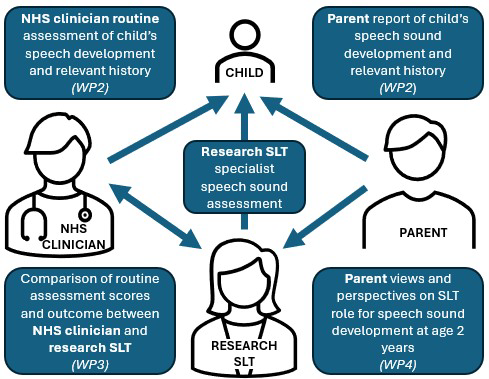
Next, we will work with an NHS clinical team in Cardiff, who see VP-born children when they are aged two years old. This is an important age for speech development. We will collect information about the children's speech (WP2) so we can understand what this looks like in more detail and compare it with what we learnt from the Bristol study (WP1). We will also collect information about how the clinicians assess speech at the moment (WP3). Importantly, we will work with parents to understand their views about the role of speech and language therapists in the 2-year-old assessments (WP4).

We will share our findings with organisations like the Welsh Government so they can make sure that NHS services are effective in helping VP-born children to achieve their potential.


BSLT Prosper process graphic

Meet the team

Dr. Sam Burr

Sharon Harvey-Lewis

Research SLT [TBC]

PhD Student [TBC]

Dr. Sam Harding

Contact us and mailing list sign-up for PROSPER

Email prosperstudy@cardiffmet.ac.uk for more information about the study or to be added to our mailing list.

Latest news - PROSPER

Follow us on BlueSky and LinkedIn

Pathology Sciences Quality Policy

Wide Off Off

Severn Pathology (North Bristol NHS Trust Pathology Sciences and UKHSA Bristol Laboratory) is committed to setting and achieving high quality standards that meet the needs and requirements of its users and patients. 

Severn Pathology will:

  • Operate a quality management system to integrate the organisation, procedures, processes, and resources, and ensure this is continually reviewed for fitness for purpose.
  • Ensure that personnel comply with the policies of North Bristol NHS Trust and UK Health Security Agency as required.
  • Establish and review quality objectives and plans to implement this quality policy and to achieve continual quality improvement.
  • Ensure that all personnel are familiar with this quality policy and comply with the quality manual and all procedures relevant to their work to ensure user satisfaction.
  • Encourage good communication between all staff.
  • Commit to the health, safety, and welfare of its staff.  Visitors to the department will be treated with respect, and due consideration will be given to their safety while on site.
  •  Commit to comply with relevant environmental legislation.
  • Uphold professional values and be committed to good professional practice and conduct.
     

Severn Pathology will comply with the requirements of all relevant regulatory bodies, population screening programmes, the Data Protection Act 2018, and ISO 15189 and is committed to:

  • The treatment of patients, samples and remains with due care and respect.
  • Identification and mitigation of actual and potential risks to patient care.
  • Staff recruitment, training, development, and retention at all levels to provide a full and effective service to its users.
  • The proper procurement and maintenance of such equipment and other resources as are needed for the provision of the service.
  • The collection, transport and handling of all specimens in such a way as to ensure the correct performance of laboratory examinations.
  • The use of examination procedures that will ensure the acceptable quality of all tests performed and are fit for their intended use.
  • Reporting results of examinations in ways which are timely, confidential, accurate and clinically useful.
  • The assessment of patient and user satisfaction, in addition to internal audit and external quality assessment, as part of its commitment to continual quality improvement.
  • Providing a comprehensive diagnostic service for Pathology, incorporating a number of national reference laboratories.
  • The safe and timely provision of blood components and products, initiation of recall and the external reporting (SABRE scheme) of transfusion related incidents.  
     

Signed by:   

Mrs N. Stock, Pathology Services Director

Mr J. Steer, UK Health Security Agency Regional Head of Operations 

Quality Policy

Antimicrobial Reference Laboratory Contacts

Wide Off Off

Antimicrobial Reference Laboratory
Level 2, Phase 1, Pathology Sciences Building
Southmead Hospital
Westbury-on-Trym
Bristol
BS10 5NB

Telephone: 0117 4146269 or 0117 4146220

Email: ARLEnquiries@nbt.nhs.uk

Test Information

Sample vials for testing

Includes details of sample types, volumes, special precautions, turnaround times & reference ranges.

Antimicrobial Reference Laboratory Contacts