What is a venous thrombosis?
Venous thromboembolism (VTE) is a term used to describe both deep vein thrombosis (DVT) and pulmonary embolism (PE). This refers to a blood clot that forms in a vein.
Being in hospital may increase your risk of developing these conditions.
This leaflet will explain what they are and the measures you and the team looking after you can take to help prevent them.
Deep vein thrombosis (DVT)
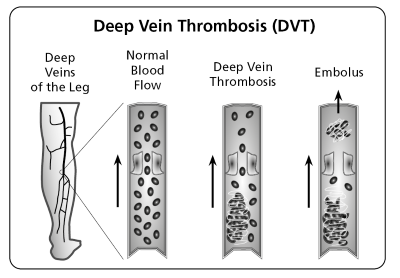
This is when a blood clot (thrombus) is formed in the deep veins – often in the legs and thighs. However, this can also occur in the upper arm, abdomen, or pelvis.
Common signs and symptoms include (but are not limited to):
- pain, tenderness and swelling of the limb (leg or arm)
- most commonly in the leg – this is usually just on one side and often the calf is affected, but there may only be ankle swelling
- if thrombosis affects the thigh veins (more common in pregnancy), the whole leg may be swollen
- the affected area may become red, hot or discoloured
If you experience any of these signs and symptoms, call your GP, Midwife or 111.
If you are diagnosed with a DVT, you will need to be started on anticoagulant medication. This is sometimes called “blood thinners”.
Even if treated promptly, some people experience lifelong pain and swelling in the affected leg. In the long-term, DVT can also cause varicose veins and leg ulcers.
Pulmonary embolism (PE)
This is when part of the clot in the deep vein breaks off and travels to the lung.
Common signs and symptoms include (but are not limited to):
- difficulty in breathing
- sudden shortness of breath
- chest pain
- rapid heart rate or fainting
- unexplained cough
- coughing up blood
If you experience any of these signs and symptoms, call 999 immediately.
This is the most serious consequence of a DVT. It can be fatal. If you are diagnosed with a PE, you will need to be started on anticoagulant medication.
Am I at risk of VTE?
VTE is a common condition, affecting 1 to 2 in every 1000 people in the UK each year.
The following factors may increase your likelihood of having a DVT or PE:
- age – the older you are, the higher the risk
- major surgery, particularly of the pelvis, abdomen, hip, knee, or for cancer
- severe trauma, such as a car accident
- if your health is poor even when you are not in hospital, for example, heart failure, lung disease, infections or cancer
- immobility when you are unwell
- being pregnant or have been pregnant in the last six weeks
- taking certain medications, especially the combined oral contraceptive pill or oral hormone replacement therapy
- if you have a strong family history of blood clots
- if you are very overweight
- if you have already had a DVT or PE
Is travelling a risk?
Long journeys can increase your risk of VTE, especially long-haul flights (over four hours). If you have recently been ill in hospital or had a big operation this will add to the risk. If you have any long journeys planned, please discuss this with a member of the healthcare team looking after you.
How can VTE be prevented?
Not all VTE can be prevented, but steps can be taken to reduce your risk.
It is very important that the team looking after you assess your individual risk (based on your reason for coming into hospital and any other risks you may have).
Simple things you can do
- Drinking plenty of water to stay hydrated (unless you are told by your healthcare team not to).
- Keeping as mobile as you can.
If you are well enough, and the staff caring for you agree it is safe, get up and walk around as much as you can.
If you cannot get up, keep your legs moving in bed (unless you are told by your healthcare team not to).
Extra things that may be suitable for some people
1. ‘Mechanical’ measures
To improve the blood flow from your legs.
- Anti-embolic stockings – which should be worn day and night until you are back to your normal or an improved level of mobility.
- Pumps on your feet and/or calves – sometimes these are only used in the operating theatre so you may not know that you have had them.
- When wearing anti-embolic stockings:
- do not roll the stockings down as they will form a tight band around your leg, which can restrict blood flow and cause skin damage
- remember to remove your stockings once daily for hygiene purposes and to check for skin discoloration/damage
- avoid using ointments/oils on your skin as this can damage the stocking fibres
- Inform a doctor or nurse if you develop numbness or tingling in your legs – your stockings are probably too tight.
- The stockings may be difficult to put on, so ask your nurse to help you. Ensure the heel is in the heel pocket, and the inspection hole is under your toes/ball of your foot.
- Anti-embolic stockings may not be suitable for you if:
- you have very swollen legs
- you have poor circulation in your legs
- you have recently had a stroke
- you have skin problems that might be made worse by the pressure
2. Anticoagulant medication
- Reduces the risk of blood clots forming in your blood vessels, and treats existing blood clots, by making your blood take longer to clot. They are sometimes called “blood thinners”.
- In this hospital, you are likely to be prescribed daily blood thinner injections to reduce your risk of developing a blood clot. You may hear it referred to as “enoxaparin”, “Inhixa” or “Clexane”.
- Some risks/reasons why these may not be suitable for you
- These medicines may increase your risk of bleeding. Your clinical team will decide if the risk of bleeding is enough to need to avoid these medications.
- The enoxaparin we use is from pigs – please speak to a member of the healthcare team looking after you for further information.
- You’ll be given more information by your healthcare team if you require these extra measures
How long am I at risk of VTE?
Even after you go home from hospital, your risk of clots can continue for up to 3 months.
Globally up to 60% of blood clots occur within 90 days of hospital discharge.
This is more likely if you remain less mobile or are not fully recovered. You may need to carry on wearing your stockings, and sometimes the anticoagulant medication will need to be continued.
What can I do once I get home?
If you have any queries or concerns after you are discharged, please contact the ward you were staying on.
- Keep as mobile as possible
- Stay well hydrated
- Avoid smoking:
- for help and advice on stopping smoking, contact NHS stop smoking service on 0300 123 1044 (England), or 0800 085 2219 (Wales). You can find more information on www.nhs.uk/smokefree
- If prescribed, take your anticoagulant as instructed
- Be aware of the symptoms of VTE as listed above
The Let’s Talk Clots app shares information about blood clots including reducing risk, signs and symptoms, diagnosis, and treatments. It also has guidance and support on recovering after a blood clot: Let's Talk Clots App | Thrombosis UK
References and further information
- Venous thromboembolism | Treatment summaries | BNF | NICE
- Why VTE Matters | Thrombosis UK
- Incidence | Background information | Deep vein thrombosis | CKS | NICE
- Know Your Clot Risk | Thrombosis UK
Date published: 9 October 2026 Review due: 9 October 2029 PI number: BFT002899