
Information for patients after abdominal and stoma surgery
Around 7 in 10 people who have stoma surgery will get a parastomal hernia. This is when there is a bulge near the stoma. This can develop gradually, increasing in size over time. The hernia happens because the tummy muscles are made weaker during surgery when the bowel is brought through the muscle to make a stoma.
Parastomal hernias can make managing the stoma tricky. They can cause:
- The stoma to not work as well.
- Pain around the stoma.
- Discomfort when moving about.
- Difficulty fitting the stoma pouch because of the shape of the stoma - this may mean the pouch is not secure.
What to do before surgery to prevent hernias
- Do gentle abdominal exercises like the ‘Core 4.’ Even if you do not already do regular exercise these will soon feel comfortable.
- Maintain a healthy weight and reduce tummy fat - this will put less pressure on the abdominal muscles.
How to help prevent hernias after surgery
- Avoid driving for at least 4 weeks after laparoscopic (keyhole) surgery. After open surgery avoid driving for at least 6 weeks, if your wounds have healed. You should also check with your insurance company.
- Avoid strenuous (very physical) activity for 8 weeks. This includes heavy lifting, pulling, pushing, or awkward movements like stretching and twisting.
- Support your stoma when you sneeze or cough.
- Use the bed roll method to get out of bed.
From 8 weeks after surgery
- You can start doing more strenuous activity while using a support belt:
- You will discuss this and be measured for it during your post-surgery clinic review.
- You should still avoid very heavy lifting and awkward movements.
- When moving smaller items follow correct manual handling advice.
- Continue your abdominal exercises to build your strength:
- We advise you not to wear the support belt when doing this so you can feel your core muscles engage.
Health factors that contribute to hernias developing
- Smoking (4x greater risk of developing a parastomal hernia).
- Persistent coughing due to COPD or asthma.
- Being overweight or having a large abdominal girth (measurement around your waist), particularly greater than 100cm.
- Being generally unfit.
- Lifting heavy items with poor manual handling technique.
Breathing to reduce intra-abdominal pressure
Intra-abdominal pressure (IAP) is the pressure inside the abdomen (tummy). Reducing IAP can help reduce the risk of hernia developing. Using safe ways to lift and move things (manual handling), and learning how to breathe well can help lower IAP.
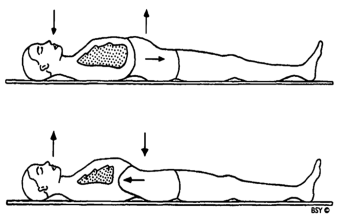
Deep breathing can help your core muscles to work more efficiently by engaging the core.
- Take a slow deep breath in through your nose.
- Expanding your abdomen and ribcage out.
- Exhale slowly out through your mouth, feeling your ribs move back inwards.
- Repeat 5-6 times.
Do not hold your breath when doing an exercise or lifting task. When exerting effort, breathe out to lower your IAP.
If the abdomen domes/pushes out during exercise (or lifting) and you can feel a raise in pressure, this is a sign of increased IAP. Stop doing any movement or exercise that causes this. Move into a better position and adjust your breathing to reduce the increase in IAP.
- Try to avoid anything that may raise IAP including:
- Preventing nausea and vomiting.
- Managing long term coughing and by seeking support from your GP or respiratory team.
- Urostomy and colostomy patients should maintain good diet and hydration to prevent constipation.
- Support your abdomen/stoma with a rolled-up towel/pillow/hand when coughing, sneezing, or blowing your nose.
The benefits of protein
- Proteins are made up of amino acids. These give your body energy and help cells renew; this helps build and heal muscles. Increasing how much protein you have before surgery will help to build supplies and condition your body. Keeping this up after surgery will help with healing and strength.
High protein foods include:
- Fortified yogurt and drinks.
- Protein powders you can add to soups and smoothies.
- Foods like fish, turkey, and chicken.
- Dairy.
- These all help repair and regain muscle tissue.
Log roll technique to get in and out of bed
- To avoid putting strain on your abdomen in the first stages of recovery (up to 2-3 months post-surgery), use the log roll technique to get in and out of bed. Please ask your stoma nurse or physiotherapist about this.
This is important immediately after surgery
Getting out of bed
- Raise one knee at a time and roll onto your side, moving your entire body in one movement.
- Lower your legs over the side of the bed.
- Use your arm furthest away from the bed to push yourself up into a sitting position.
Getting into bed
- Sit on the side of the bed with the back of your knees against the bed.
- Lower your body to the bed surface with use of your arm, furthest away from the side of the bed you are going to lay on.
- Slowly lift both legs onto the bed to meet your body, keeping your knees bent.
- Roll onto your back and slowly lower one leg at a time.
Exercises
From 3-4 days post-surgery up to 8 weeks
Tummy tightening breathing deep core-back
- Lie on your back, on the bed, or floor with your knees bent.
- Take a deep breath in.
- As you exhale, draw your abdominal muscles down towards your spine and ribs towards your pelvis.
- Hold this contraction for 2-3 seconds while still breathing. Then release and repeat 5 times.
- Slowly build up to holding the contraction for 10-15 seconds and repeat 5-10 times.
Deep core side
- Lie on your side with knees bent.
- Allow your stomach to drop toward the floor.
- Take a deep breath in and exhale, drawing your abdominal muscles in and towards your back, pulling your ribs toward your pelvis, and lifting your tummy away from the floor.
- Hold the contraction for 2-3 seconds then release and repeat 5 times.
- Slowly build up to holding the contraction for 10-15 seconds and repeat 5-10 times.
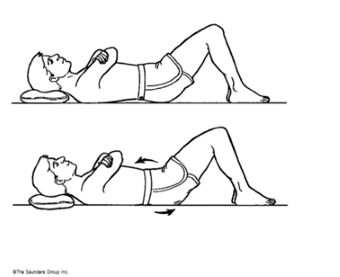
Pelvic tilt
- Lie on your back, on the bed/floor with your knees bent.
- Press your lower back into the bed or floor.
- Rock your pelvis up towards your head, feeling a tightening in your tummy and bottom muscles, slightly pulling your ribs and pelvis together.
- Hold the contraction for a second and return to the neutral position. Repeat 5 times - build to 20 repetitions.
From 7 days post-surgery
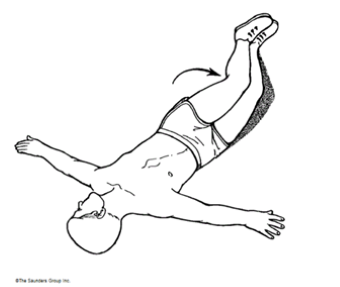
Knee rolls
- Lie on your back on the bed or floor with your knees bent.
- Keep your knees and thighs together, exhale. Slowly drop your knees as far as is comfortable, rotating your pelvis and hips to one side.
- Keep your shoulders fixed to the floor as you roll. Inhale and breathe normally, and hold the position for a few seconds. Drop your knees a little to start with, and work on increasing this over time.
- Exhale and return your knees up to the starting position, use your core muscles to draw them up slowly. Repeat on alternate side 10-15 times.
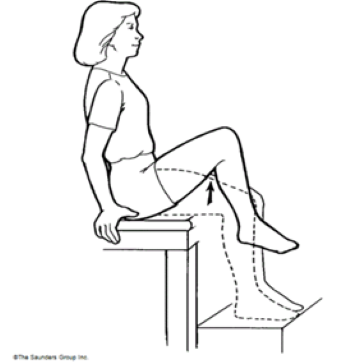
Seated knee lifts
- Sit toward the edge of a chair with your back straight and unsupported (not leaning back).
- Engage your deep core, pulling your tummy toward your spine and breathe normally. Lift one foot from the floor a short distance, hold for 2 seconds
- then return foot flat to the floor.
- Repeat 10-20 times on alternate sides. You can increase the height you raise your foot from the floor over time.
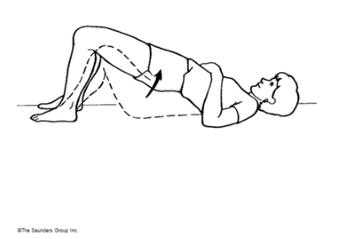
Hip bridge
- Exhale and pull your tummy toward your spine, tilt your pelvis toward your head and lift your tailbone off the floor. Raise up a short way pushing from your heels, curling up through your spine.
- Breathe in and normally, holding the position for 2 seconds.
- Exhale and slowly lower yourself curling your spine back to the floor, relax and repeat 10-15 times.
From 6-16 weeks
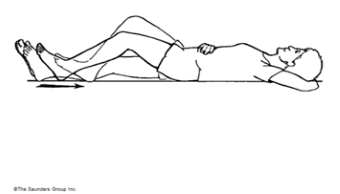
Leg slides
- Lie on your back on the bed/floor with knees bent up and core pulled toward your spine.
- Exhale and slide one foot slowly away from you straightening your leg and breathe in. Exhale and slowly draw your foot back to the starting position. Keep control of the core by pulling it towards your spine. Repeat on alternate sides 10-20 times.
- As you get stronger you could increase the intensity by raising the opposite arm to leg up, and rotating it back past your head to your ear. Move the arm and opposite leg at the same time.
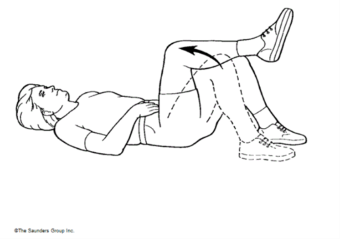
Knee circles
- Lie on the bed/floor or sit in a chair with your back straight and unsupported, exhale, pull your core towards your spine to engage your deep core, breathe normally.
- Exhale and lift one knee to 90 degrees (right angle), breathe normally keeping the core engaged.
- Circle the leg making a clear movement to one side, towards the chest, towards the opposite knee and to the back completing a full circle.
- Lower the foot back to the floor and repeat on the opposite side, alternating 10-20 times.
Hip bridge and inner thigh squeeze
- Lie on the bed/floor with your knees bent up and place a small ball or rolled up towel between your knees and hold firmly.
- Exhale and pull your tummy towards your spine, tilt your pelvis towards your head and lift your tailbone off the floor. Raise your body up, curling your spine off the surface, pushing from your heels until your body runs straight from your head to your knees.
- Breathe in and normally, holding the position for 2-5 seconds. Exhale and lower your body back to the floor curling your spine flat. Repeat 15-20 times.
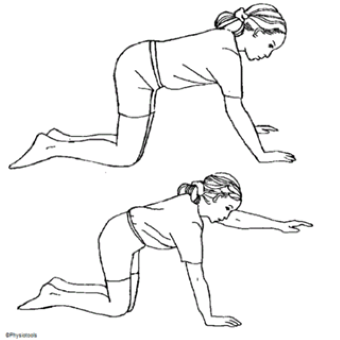
Half superman with arms
- Start on your hands and knees, making sure hands are positioned under your shoulders, and hips over your knees.
- Pull your core to your spine to engage your deep abdominal muscles.
- Slide one hand away from you, keeping your arm stretched out, until your hand just leaves the floor. Hold the position for 2-5 seconds and slowly return your hand to the starting position. Always keep control of your core.
- Repeat on alternate sides 15-20 times.
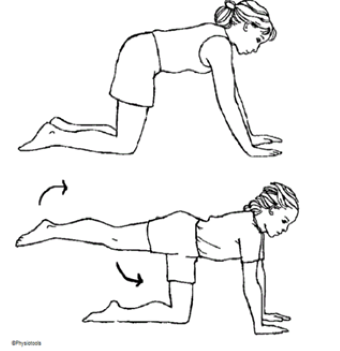
Half superman with legs
- Start on your hands and knees, making sure hands are positioned under your shoulders, and hips over your knees.
- Pull your core to your spine to engage your deep abdominal muscles.
- Slowly slide your foot away from you until your leg is straight and your foot lifts away from the floor. Hold this position for 2-5 seconds keeping your core engaged. Slowly return your foot back to the starting position.
- Repeat on alternate legs 15-20 times.
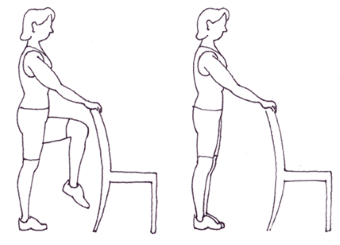
Standing knee lifts
- Stand tall with your back straight and core pulled towards your spine. Hold onto the back of a chair with one or both hands for stability if needed.
- Exhale and slowly lift one knee up as far as is comfortable, breathe out and normally while holding the position for 2-5 seconds, maintaining control of your core. Exhale and lower your foot to the floor.
- Repeat on alternate legs 15-20 times.
- To make this a little harder and if your balance is good – raise both arms above your head and proceed to lift one knee at a time alternately.
From 14+ weeks
Continue the previous exercises alongside these.
Toe tap
- Lie on the bed/floor or with your knees bent up and engage your core, pulling your tummy to the spine. Exhale and pull one knee up to 90 degrees (right angle) followed by the second knee.
- Breathe in, and on exhale tap one foot down to the floor while keeping the opposite leg still. Breathe in as you bring the leg back up and repeat on the opposite side.
- Repeat 5 to 20 times on each side.
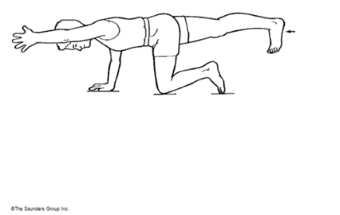
Full superman
- Start on your hands and knees, making sure hands are positioned under your shoulders, and hips over your knees. Pull your core to your spine to engage your deep abdominal muscles.
- Slowly straighten out your right leg and left arm until both your foot and hand are off the floor. Start by raising a short distance off the floor and increasing this over time, if not able to lift parallel with the body to start with. Control your pose keeping the core engaged and not overextending the arm or leg.
- Hold the pose for a few seconds, increasing this over time.
- Return your arm and leg slowly to the start position and repeat on the opposite side.
- Repeat 20 times.
Recommended reading
- The bowel cancer recovery toolkit by Sarah Russell.
Further information and support
- Breathing and Movements For People With a Stoma including a video
- Information about parastomal hernias from Colostomy UK
- Video of the log roll technique
- Coloplast charter Core 4 abdominal exercises
© North Bristol NHS Trust. This edition published December 2025. Review due December 2028 NBT003636