
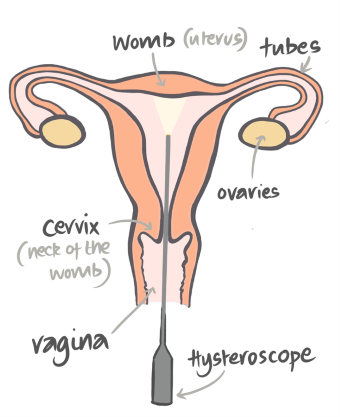
What is hysteroscopy?
Hysteroscopy is a procedure that allows the gynaecologist to see inside the uterus (womb). A thin tube called a hysteroscope is inserted into the uterus. This has a light source and a camera, which shows images of the inside of the uterus on a television monitor.
Hysteroscopy is a quick procedure and is usually done in the outpatient setting. In more complicated cases, or if it is your preference, a sedation or general anaesthetic may be required.
Hysteroscopy is used to investigate abnormal bleeding, infertility and to remove lost coils. A hysteroscopy might show:
- abnormal endometrium (lining of the womb)
- endometrial polyp (non-cancerous growths of endometrium)
- fibroid (muscular growth of the uterus)
- abnormal shape of the uterus
- adhesions (scarring on the inside of the uterus)
- retained pregnancy tissue (RPOC)
What does an outpatient hysteroscopy involve?
Outpatient hysteroscopy is often preferred to having a general anaesthetic because:
- the procedure is quicker
- recovery is faster and less time off normal activities is needed.
- the rate of complications is lower
The appointment normally lasts up to 30 minutes. A doctor or nurse will do your procedure, and a nurse or healthcare assistant will assist. Outpatient hysteroscopy currently take place in the gynaecology outpatient department (Concorde House).
You should eat normally beforehand. It is a good idea to take paracetamol and ibuprofen (if you are normally able to take ibuprofen) an hour before the procedure. Please inform us before your hysteroscopy visit if you are taking any blood thinning medications. We will make a plan with you if you should temporarily stop or continue these medications. If you are aged under 55 years old you must avoid sex or use contraception from your last period up until your procedure. We will ask you to provide a urine sample for pregnancy testing on the day of your procedure.
You will be asked to remove clothing below the waist. You will lie on a couch with your feet in footrests and a sheet covering your lower half. A speculum may be used to open the vagina (similar to a smear test). Sometimes local anaesthetic may be injected into the cervix or inserted into the inside of the uterus. The hysteroscope is then inserted and fluid gently pumped into the uterus. This may be slightly uncomfortable but passes quickly. The inside of your uterus will be visible on a screen so any abnormalities can be identified. This part of the procedure lasts a few minutes.
Using a thin straw-like device a small sample of tissue from the lining of the womb (endometrial biopsy) may be taken. Sometimes fibroids or polyps can be treated during your hysteroscopy using fine surgical instruments.
After the procedure you can go home and continue with your normal activities. We will write to you with the results of any biopsies within the next few weeks.
How do we remove a polyp or fibroid in hysteroscopy?
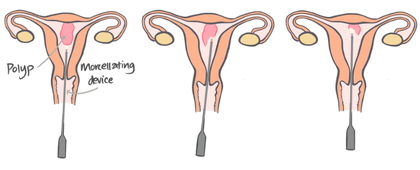
Abnormal bleeding can be caused by fibroids or polyps. A fibroid is a muscular growth of the uterus, which can cause heavy periods. A polyp is like a skin tag of the lining of the womb. If a fibroid or a polyp is seen at the time of hysteroscopy or on an earlier ultrasound scan then it can be resected. Sometimes a speculum is inserted, and local anaesthetic injected into the cervix if it hasn’t been already. This makes the cervix numb so that it isn’t uncomfortable for us to open (dilate) the cervical canal up a few more millimetres. The polyp is removed using a fine instrument called a polyp forceps or a morcellating device. This device ‘eats’ up the polyp and we can see it on the screen. This is no more painful than having a standard hysteroscopy but does take a few extra minutes.
We recommend having a fibroid or polyp resected whilst you are asleep if:
- you find vaginal examinations or transvaginal scan particularly uncomfortable
- the fibroid or polyp is very large or very calcified and would take a long time to resect whilst you are awake
- the fibroid or polyp is very vascular or has a lot of blood vessels around it that might cause bleeding
Having a progesterone coil (Mirena / Levosert) fitted at hysteroscopy
If you are coming to hysteroscopy, you can have a coil fitted during your visit. We offer a progesterone hormone coil for the following reasons:
- heavy periods
- painful periods
- contraception
- HRT (progesterone component)
- women with postmenopausal bleeding who are overweight – this stops the development of abnormal cells of the womb lining
- women with known abnormal cells in the lining of the womb (regardless of weight)
- women with polycystic ovarian syndrome (PCOS)
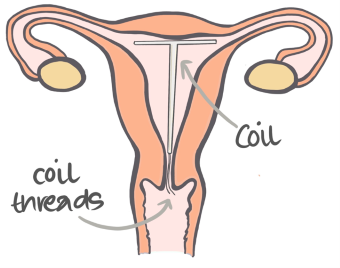
When having a coil fitted there is a small chance that the coil could perforate or go through the wall of the womb. We recommend that you don’t rely on the coil for contraception until you have had your coil threads checked, either by feeling yourself in 4 to 6 weeks’ time or having your practice nurse perform a speculum and see the threads.
If you are coming to hysteroscopy to have your coil removed, we recommend avoiding unprotected sex in the week before to prevent unwanted pregnancy.
Pain relief options
Most people find outpatient hysteroscopy mildly uncomfortable and are able to tolerate the procedure very well. The average maximum pain score for hysteroscopy in our department is 5 to 6 out of 10. This falls to 2 out of 10 after the procedure. There are lots of pain relief options available (see opposite) to make the experience as positive for you as possible.
Local anaesthetic block – these are injections of local anaesthetic which are injected into the cervix. This works very quickly and allows us to open the cervix a few more millimetres if need be.
Instillagel – this is an anaesthetic gel that is inserted into the womb and helps to open the cervix whilst numbing the cervical canal and inside the womb.
Entonox – this is gas and air that is typically used in childbirth. It can be used from the start.
Penthrox – this is an anaesthetic gas that can be used via a special inhaler. It is particularly good for providing pain relief and is regularly used in A&E for pulling broken bones. If you are someone who finds speculums very sore, using Penthrox may be advisable. For more information please see our ‘Penthrox in Gynaecology’ leaflet.
Having a hysteroscopy under a sedation or general anaesthetic
In more complicated cases a general or spinal anaesthetic may be required for example if:
- you have a fibroid or polyp that is too big for removal whilst you are awake
- you are having another operation performed at the same time
- you find vaginal examination extremely painful
- you can also opt to have general anaesthetic if it is your personal preference
Some women will require a pre-operative assessment to ensure you are fit enough for a general anaesthetic. This may include blood tests, ECG (tracing of the heart), and physical examination. You must bring a current list of any medication you are taking and specifically let us know if you are taking any blood thinning medication.
You cannot eat or drink anything except clear fluids for 6 hours before your procedure. This will be discussed at your pre-operative assessment. Most people will be discharged on the same day as their procedure. You will be unable to drive for 48 hours after your operation. It is important that you are not alone for the first 48 hours.
The procedure is the same as hysteroscopy in outpatients except you are asleep or numb from the waist down. These procedures happen in a surgical operating theatre and not in the gynaecology outpatients department. After your hysteroscopy, you may feel groggy and sometimes people may feel sick. These are common side effects of the general anaesthetic and will pass quickly.
When you are up and about, eating and drinking, and able to pass urine you will be able to go home. You will be able to continue your normal daily activities within 1 to 2 days. We advise you take 2 days off work.
What complications can occur?
2 in 1000 women will experience a serious complication from their diagnostic hysteroscopy. This number is likely to be much lower if performed in outpatients. Common complications include bleeding, infection (frequently of the womb lining or urine), and feeling faint during the procedure.
Serious potential complications include:
- damage to the uterus
- failure to enter the uterus (this is more likely if you have had LLETZ treatments on your cervix in the past).
- blood clots in the lungs or legs (thrombosis).
- perforation and damage to internal organs, including bowel, bladder and major blood vessels.
- fluid overload
Failure to enter the womb is more common in post-menopausal women, women who have not had babies delivered vaginally and women who have had a LLETZ procedure (loop excision of the cervix for abnormal cervical smears). If this is the case, then we would book you to come back for a hysteroscopy under general anaesthetic. This is because when you are asleep we can use certain instruments to open the cervix and enter the womb more easily.
If perforation is suspected, we will monitor you more closely for the next few hours and may ask you to stay in overnight. We often will give you a course of antibiotics. If damage to the internal organs is suspected we might do extra scans of your tummy like an ultrasound or CT scan. Ultimately, we might perform a laparoscopy (keyhole camera in the abdomen) or laparotomy (cut on the abdomen) to check for damage and repair it if present.
Fluid overload happens when a large amount of fluid has been inserted into the womb and absorbed by the woman’s body. This is unusual as we keep a close eye on the amount of fluid pumped in and the amount coming out and stop the procedure if we are reaching a large volume. If fluid overload is suspected, you may need to stay in hospital for a few hours for observation and blood tests. Very rarely fluid ends up in the lungs making you short of breath. Fluid overload is more likely when you are having a long procedure where a large fibroid or polyp is being resected, or if you have significant heart or lung issues.
What to expect after my hysteroscopy
It is normal to experience vaginal spotting for the first few days after your hysteroscopy, this might be heavier if you have had a polyp or fibroid resected. It is advisable to use sanitary towels (instead of tampons) and avoid having sex, baths or swimming until bleeding has stopped. This helps to reduce the rates of infection in the womb. Sometimes women experience crampy lower abdominal pain, this is short-lived, and you can take simple painkillers such as paracetamol and ibuprofen (if you are normally able to take ibuprofen).
Infections of the lining of the womb may happen about 7 to 10 days after the procedure. The main symptoms of an infection include smelly discharge, lower tummy pain, worsening bleeding, and fevers. If this is the case, then we recommend speaking to your GP and having a course of oral antibiotics.
We do not arrange routine hospital follow up appointments. If you have any problems or concerns, you can contact the Gynaecology secretaries or your GP.
- Gynaecology Secretaries 0117 414 6791 option 4
Further information
RCOG – Outpatient hysteroscopy patient information leaflet Outpatient hysteroscopy | RCOG
Date published: 1 October 2026 Review due: 31 October 2029 PI number: BFT002442